Wednesday, July 30, 2008

Book 10 – The Spellman Files

By Lisa Lutz

With movies, I every so often delve into a classic, but the bulk of what I consume is recent. Same with books. Though not exactly a ‘new release’ kinda girl when it comes to contemporary reading (publish date being 10+ years ago) since I mostly get my fix free via public library and never buy new. The past year or so, I’ve been making a habit of perusing used bookstores whenever I visit "English-speaking" areas, and thus to my delight have discovered more recent works. Take The Spellman Files, for instance, which came out just -gasp- last year!

Isabel’s parents, Albert and Olivia Spellman, run a private detective agency called Spellman Investigations from their multi-storied Victorian house in San Francisco. They employ Isabel and Al's brother, Uncle Ray, both licensed PIs, and would sometimes give the odd tailing job to their 14-year-old daughter, Rae. This itself isn't so unusual since 28-year-old Isabel first started helping out on cases when she was only 12. David, the eldest son and a high-powered lawyer, never having been interested in the family business, is possibly the only sensible member of the family to have moved out of the Spellman nest.

“Most people don’t spy on each other. Most people don’t run background checks on their friends. Most people aren’t suspicious of everyone they meet. Most people aren’t like us.”

This is the reality check that Isabel tries to impart upon adolescent Rae after a particularly trying week. It turns out that their parents have sent Rae to spy on Isabel and Daniel, who soon becomes ex-boyfriend #9. He just couldn’t handle her and her oddball family! When the Spellmans aren’t working on cases, or spying on each other, they’re busy tracking down wayward Uncle Ray on his drunken, poker binges in Las Vegas.

There are family melodramas for sure. Or more like outright declarations of war (the battle between Rae and Uncle Ray is pretty good stuff). But there are also interesting insights into detective work: the exciting, the not-so-exciting, and the overbearingly irksom, especially when both the personal and professional gets all messily entangled within the "family business".

Which brings us to Isabel’s love life, or lack of one thereof. When Isabel realizes she’ll never find a lasting relationship if her family keeps bugging her room and running credit checks on potential suitors, she finally threatens to quit and move out of the Spellman house. But her savvier parents strike a deal: if she can crack a 10-year-old unsolved case about a missing person named Andrew Snow, she’s free to go. This is where Isabel jumps into the case with such obstinacy no living PI has ever seen before!

“An addictively entertaining read…”
“Fast-paced, irreverent and very funny debut…”
“She’s part Bridget Jones, part Colombo…”

These blurbs are blessed by the likes of USA Today, People and Glamour. Yup, TSF was a bit of a mainstream hit and a NYT bestseller which became promptly optioned for movie rights. Not surprising, since TSF was so much fun to read. Though it does get a little too cutesy at times, á la The Royal Tanenbaums meet Dashiel Hammett, this is still a wickedly funny, and at over 350 pages, a substantially enjoyable read.

So help me out folks: keep your eyes peeled for the sequel, The Curse of the Spellmans!

Wednesday, July 02, 2008

Book 9 – Fun Home: A Family Tragicomic

By Alison Bechdel

This critically acclaimed graphic novel was highly recommended by Olman’s sister. Olman then picked up a copy in TO, read it and lent it to his aunt, who then passed it back onto me when we were staying at her lovely cottage by Georgian Bay, Ontario.

I very much agree with the first half of Olman’s review, but understand the other half is based on his own taste and perspective.

The premise may not sound terribly inviting to some: an autobiographical graphic novel about a queer girl growing up in a tragically dysfunctional family. But Bechdel’s story is, nevertheless, wonderfully and exceptionally told. Just flipping through the pages, the casual peruser may feel that there is nothing particularly remarkable about the eloquent illustrations. And even though the narrative structure is fairly nonlinear throughout, at heart Bechdel uses the framing device of “author looking back at her past” in order to posthumously reconcile with her father, who never came out of the closet.

Once you start reading, however, you soon realize that Fun Home is a rare combination, where both mediums, image and text, are executed with harmonious insight and beauty by the same author/artist. Bechdel's various accounts: of her growing up in a Victorian-style funeral home (hence the title), her awkward relationship with her father, her obsessive-compulsive diary entries that become more and more indecipherable as she's gripped by adolescent uncertainties, flashbacks of family trips to New York City, her coming-out in college and yes, even all those literary references... they all made for a fascinating, engrossing, heartfelt, moving and very personal story.

Douglas Wolk writes an in-depth review that really does this work justice, if you’re considering checking this one out. I myself would certainly recommend it!

Monday, June 30, 2008

Book 8 – Fight Club

By Chuck Palahniuk

From the refreshingly feminist romance of My Brilliant Career to the male-driven mental maelstrom that is Fight Club, there is no pattern to my pursuit of leisurely reading!

I’m sure all you 50-bookers are already well acquainted as to what Fight Club is all about, mostly likely thanks to David Fincher’s ambitious 1999 movie adaptation (which I saw when it first debuted). I see now how faithfully Fincher captured the voice of this wacky cult writer, and then some. Like the flick, the book crackles and pops with Palahniuk’s brand of nihilistic humour and seethes with a tightly wound masculine energy.

Palahniuk’s sordid world of basement support groups and clandestine fight clubs; his endearingly deranged protagonists caught up in familiar themes of male identity crisis and individual worth in society; the twisted use of plot devices, such as a schizophrenic love triangle, provide the perfect boxing ring for Palahniuk to make his irreverent jabs and punches at the big C’s: Consumerism, Conformism and Corporations.

The fight clubs of men beating up men somehow evolve into an underground society of brotherly militants conspiring to wreak pure, unadulterated mischief upon society, and then of course, this becomes a global network of terrorist cells to bring down civilization as we know it!

Despite the constant lust for mayhem and anarchy, I still appreciated the post 9/11 relevance of Fight Club. You know that Palahniuk wrote it all in good clean fun. Though his voice calls for chaos, the writing itself is tight and spare, and the style articulate, distinct and most of all, not too self-consciously clever. All in all, an entertainingly excellent read!

Thursday, June 12, 2008

Book 7 – My Brilliant Career

By Miles Franklin

This wonderfully brilliant novel was published in 1901, but it feels so timeless and universal it could have been written yesterday, albeit by a precociously gifted young writer. This is the kind of book that makes me realize why I love reading great fiction so much. It also makes a 6 hour train ride to Toronto so much breezier and sweeter!

The tale is archetypically simple yet strikingly and passionately written. Sybylla Melvyn is a fiery, headstrong girl growing up in an impoverished farm way out in the Australian bush. Too clever for her own good, she longs for an artistic life far removed from the reality of unending farmwork and drudgery. By a stroke of good fortune, Sybylla is sent to live with her wealthy grandmother in her estate along with her jovial uncle and lovely aunt. She soon strikes up an unlikely romance with the neighbouring landowner, Harry Beecham.

Yes, this all sounds like a typical Victorian fairy tale, except this is where our plucky heroine turns down the man at the end, refusing to marry in order to maintain a sense of true independence. This is the kind of totally left-field ending that’s practically unheard of at that period in history. What’s even more remarkable is that the book was written when the author was only 16. You gotta wonder where a young girl, even a precocious one, got such ideas having only grown up in an isolated rural community in New South Wales at the turn-of-the-century, as this is truly a feminist's happy ending.

The book was a big hit in Australia and abroad, and much speculation was made about the autobiographical aspects of the novel. Indeed the fictional Sybylla Melvyn and the young Franklin are very much one and the same (the author’s full name is Stella Franklin, as she used her more masculine-sounding middle name, Miles, for professional and practical reasons). Sybylla/Stella is impulsive, egotistical and self-centred, but somehow she becomes one of the most endearing characters I've come across in fiction in a long while, and I was quickly hooked. This is also definitely a tale from the Australian bush, a world which Franklin knows intimately. There are plenty of rich, detailed accounts of the landscape and life in the outback, from the harsh and impoverished conditions of nomadic farmhands and sheepherders to the privileged and leisurely pursuits of the upper classes.

The average male reader may not be so interested in this book. But if you’re a fan of Jane Austen and such, this is a must-read. Definitely recommended for female readers young and old, as this has been a highlight read of the year so far! It’s even inspired me to re-rent the equally brilliant 1979 film adaptation by Gillian Armstrong, featuring a young Judy Davis and Sam Neill!

Sunday, June 01, 2008

Book 6 – Jenny & The Jaws of Life

By Jincy Willett

This short story collection was published in 1987 and reprinted in 2002 with a foreword by David Sedaris, who first discovered JATHJOL in the New Fiction section of the Chicago Public Library. The stories left a profound impression on the young Sedaris, 'a voracious reader then, a student shoplifting for a voice…'

Willett’s stories have also been described as ‘wonderfully funny’. Sadly, however, I personally found the majority of them not very amusing nor impressionable. After writing this review 3 months after reading them, I find I can’t recall what most of them were about. It also didn't help that I've been forcing myself to finish this book since early last year.

I find Willett’s expository writing style very bland and kind of boring. There is very little dialogue, external or internal, and she has a tendency to employ the 3rd person, which results in a fairy tale-like narratives about unconventional, complex people living ordinary lives. But this also has the adverse effect of creating a greater distance for the reader, at least for this one.

Out of the dozen or so stories, I found the following few worthwhile:

“The Haunting of the Lingards” -- How a married couple of differing personalities and beliefs get along with each other.

“Melinda Falling” -- How a man loves an extremely accident-prone woman, who grows to a ripe old age, but nevertheless still rails at God.

“Justine Laughs At Death” – a clever one about Evil personified as an immortal serial killer, a kind of Jack the Ripper in the 20th c. who picks his victims out of a list in his black book. Over the course of many nights, he gets phone calls from various females, young and old, who seem impervious to his cruel and wicked banter. In a fit of rage he calls the phone company and a rep named Justine answers. She turns out to be the representative of all his past victims and is Vengeance, Justice, Revenge, and Woman rolled into a convenient package. Sadly, the story ends rather anti-climactically.

The best story, the funniest and most memorable, is “The Best of Betty”, written entirely in the format of an advice column.

And there you go, a review to quickly get it over with. Next!

Monday, May 12, 2008

Book 5 – Great Apes

By Will Self

"Darwin was wrong. Man's still an ape." -- Gene Kelly

Most reasonably intelligent and educated people familiar with evolution know that humans are part of the same family as the great apes, made up of gorillas, orangutans and chimpanzees. And it's fairly common knowledge that humans and chimps are at least 99 percent identical in terms of basic biological chemistry. Heck, there's even been speculation about the possibility of producing a `human-chimp' hybrid with artificial insemination, without any help from genetic engineers (if it hasn’t been done already). It’s a wonder that our genetic cousins don’t get much respect, instead getting demonized or exploited in popular culture.

But these aren’t necessarily the most perturbing facts. Spend enough time observing chimpanzees or bonobos in a zoo, and you quickly understand how very few differences there are between human and chimp society. Having long been fascinated by these parallels, I had great anticipation in seeing how Will Self would use these ideas in his novel. He did not disappoint, as he took the ideas and went for a Swiftian marathon run with them.

Simon Dykes has all the makings of a talented and successful painter in London. Controversial in both life and art, he’s hedonistic, brooding, emotionally arrested and self-destructive (hmm, a bit like the author himself). He has a love-hate relationship with his inner social circle of conceptual artists, agents and art dealers, not to mention a stormy partnership with his girlfriend, Sarah. One fateful night after partying, he has animalistic sex with Sarah while high on coke and ecstasy, and wakes up the next morning in a world where every single person, himself included, has completely transformed into hairy beastly chimpanzees. The only difference is that Simon knows he’s still Simon, a man trapped in a chimp body in a chimp world, while everyone else keeps acting like bloody stupid apes. They don’t speak, instead they pant-hoot, gesticulate and sniff each other’s arses. They take 2-minute orgy breaks in public. On the bloody street, for chrissakes. Naturally, Simon goes apeshit (or humanshit, rather) and is soon thrown into a mental hospital. Soon enough, our tragic protagonist is taken under the wing of Dr. Zack Busner, who in turn becomes obsessed with the strange case of Simon and his human delusion.

Although the central premise is not exactly original (a kind of satirical and Sacksian inversion of The Planet of the Apes, which is playfully referred to as The Planet of the Humans in the novel), it does allow the author to flesh out the man vs chimp theme in many clever ways. There are many brilliant passages throughout the novel and you get the sense that the author is having a helluva hoot, and a scatological fun time, writing this up. I found his “observations” about social hierarchies and niceties the most humourous:

The three chimps greeted one another with stentorian pant-hoots…
Busner, ready to lash out at any impropriety, was quite disarmed when Franklin presented to him with great and groveling alacrity. The big chimp pushed his arse towards Busner, while most of his upper body was hugging the path, flicking the while.

“’Hoo’ Dr Busner, what a pleasure to encounter you and your magnificent ischial scrag – I’ve been an admirer of yours for many years.”


Despite my overall enjoyment, my only criticisms were that the novel, at just over 400 pages, was too long. The “Ape Who Mistook Himself For a Man” idea can’t be sustained for such a length and would have made a far better novella. My interest would wax and wane whenever the story dragged on too much, or a darkly funny section would pick things up again. The ending, where Simon and Dr. Busner, journey to meet the chimp version of Jane Goodall who's studying the "wild humans of Gombe", was a bit obvious as well as somewhat of a let-down.

Monday, February 25, 2008

Book 4 – Animal Farm

By George Orwell

I felt just like how Crumbolst felt after finishing To Kill a Mockingbird: “What can I say about a book that's been discussed by millions over the past half century?”

Better to read what June 23rd Project wrote about the effect this powerful novella had on a Belarusian teacher visiting his high school during an exchange program.

For some sad and unforgivable reason, I never studied Animal Farm at school. I’m just glad I finally had the initiative to read this when I was sick at home one late, grey winter day.

Friday, February 15, 2008

Book 3 – Crow Lake

By Mary Lawson

This sat in my on-deck shelf for the longest time, mostly because I kept seeing it in used book stores thinking it was the kind of book that wasn’t really worth holding onto. But Crow Lake is far from a being a ‘remainder bin’ kind of book.

I don’t usually seek out this type of fiction. There is a bounty of Canadian books mining the territory of family hardship and growing up in the harsh unforgiving landscape yada-yada-yada that I’m simply not that interested in. Crow Lake piqued my interest because it was about an aquatic zoologist and a review I read way back when said there were beautiful passages about the natural world. I guess with anything in life, every now and then it can be a character-building process to delve into something you don’t normally do, especially with something that’s done well.

The story begins with a young girl named Kate who lives in a remote farming community in northern Ontario. Her brother, Matt, is a gifted student with a love of the natural world, spending countless hours studying the tiny inhabitants of the pond that’s situated on their land, from water insects to microscopic organisms. Luke teaches his little sister everything he knows about the pond ecosystem.

One tragic day, Kate, along with Matt, baby sister Bo, and eldest brother, Luke, are suddenly orphaned when their parents die in a car accident. Luke, who was about to attend teacher’s college, and Matt, barely out of high school, suddenly give up their aspirations to raise Kate and Bo at the farmhouse.

Then fast-forward to Kate, who’s grown up to be a brilliant zoologist in Toronto, but who has also grown distant, geographically and emotionally, from her siblings, who have never left their hometown. When Kate develops relationship issues with a fellow scholar when things get serious, she must confront her past if she doesn’t want to lose what could be the love of her life.

Ok, my summary towards the end got caught up in some clichés there, but really, this was a well-written book exploring the protagonist’s underlying, complex emotions with deft patience and control. And what's more, there were indeed satisfying and quietly beautiful passages about the natural landscape. Here's a sample:

---
By September everything was in seed. The seed heads shook their contents over you as you passed and the burrs clung to your clothes. Some days thousands of milkweed pods would burst open together, triggered by the heat of the sun; thousands and thousands of small silent explosions repeating themselves in salvos down the miles of tracks. On those days I walked through clouds of silken down drifting about like smoke in the morning breeze.
---

The understated quality and subtle character studies are probably why this novel hasn’t made any significant emotional impact on the general reader. There’s nothing catchy, no wow factor. But if you’re looking for a quietly thoughtful story, this is worth delving into.

Monday, January 28, 2008

Book 2 – Blood Is the New Black

By Valerie Stivers

Fashion is a bloodsucking business. Literally.

When you have this as a tagline, either you totally want to find out more, or you don’t. Like when you’re nursing a hangover and you somehow managed to haul your ass over to the new releases section of the nearest video store, and you’re dumbly gazing at the catchy cover, well, you just need to know whether it can deliver the mindless yet engaging entertainment you wish to occupy your mind with for the next few hours. And Blood Is the New Black is just that, um, except it’s in book form.

So you've got the heroine, Kate McGraw, who, you know, is plucky and independently minded, not a fashion slave at all, because she's got her own retro-style going and she wants to be a doctor or lawyer one day. Somehow, her aunt pulls strings and she ends up working as an intern at Tasty magazine. Like any fresh young upstart, Kate is instantly disliked by her immediate boss, the uber-bitchy Lexa, and catches the eye of the cute in-house photographer, James. However, she also falls under the spell of the ethereally graceful and mysterious editor-in-chief, Lillian, and gets herself embroiled in the shocking “fashion murders”, where the victims are inexplicably drained of their blood, and found near photo shoots and parties whenever her freakishly pale co-workers are around.

As Olman already pointed out in his review last year, the manifestation of the vampire myth in the modern, fashion world is fantastic. It cleverly integrates all the vampire clichés, updates some of them and wittily critiques high fashion. And I must say, I agree with this statement. Here are some good quotes that perfectly illustrates why there are so many fashion victims...

“I learned that vampires are always seeking others who can join their ranks. They have a pathological need for followers. That’s why they’re in fashion. But very few humans can make the transformation.“

“… Now that she’s marked you, you’re like a beacon. Our kind can sense you. And with each bite, your ability to evade attack lessens. Most blood donors end up it in the end. You’ll see them shopping in Nolita, or at the tents in Bryant Park during Fashion Week, just waiting to be picked off.”

Now, I’m not exactly on the cutting edge of fashion, but I’m a woman and like most women, I loooooove clothes. So unlike Olman, I enjoyed the noisy-chatty and at times, very clever-nasty, female-driven dialogue and the detailed references to what the various characters were wearing. When you have lines like:

“When Reese leaves, the silence in our closet-slash-office is thicker than Pringle cashmere.”

“My aunt walks into the kitchen wrapped in a fuchsia silk robe with a contrast-band of brilliant blue around the waist and blue bias-tape trim.”

“Let me see it,” she says, taking my wrist and examining the tacky puncture wounds. “This is nothing! This is just a sip. You’ll want to shop a little bit more than usual, but that’s it. And you’ll look good. Anemia is chic!”

It’s like Sex & The City meets The Devil Wears Prada meets Buffy! What more can a girl ask for?

Monday, January 21, 2008

Book 1 – The Land of Laughs

By Jonathan Carroll

The Land of Laughs had been on my list forever, back in the day when I was intrigued by fantasy-realism (like Peter S. Beagle’s A Fine and Private Place or Jack Finney’s Time and Again) and when I saw it at a used bookstore in Berkeley, I went ‘what the heck’.

The novel begins quite conventionally (hence realistically) with Thomas Abbey, who lives a ho-hum existence as a teacher at an all-boy’s school somewhere in New England. His one true passion is the work of Marshall France, a mysterious and reclusive writer of fantastic children’s books, who died at 44. Although well-known, no biography exists of France, due to the author’s difficult family. In a fit of early-life crisis, Thomas decides to go on a sabbatical. Soon he and new girlfriend, Saxony Gardner, journey to France’s isolated hometown in Missouri where they’re warmly received, surprisingly, by France’s daughter, Anna. Even more surprising, they're eventually granted permission to embark on writing the long-awaited Marshall France biography. For a period of time, everything seems to be going well. Then strange things start to happen to Thomas, like seeing the face of a local fleetingly transform into one of France’s beloved characters, or overhearing a bull terrier muttering to himself in his sleep. Gradually, Thomas and Saxony learn that the vivid imagination of Marshall France has had a persisting influence over the town of Galen, even long after his death.

TLoL is also categorized as slipstream, as opposed to conventional magic realism or fantasy. As much as I was enjoying the realistic, almost rom-com style narrative of Thomas and Saxony meeting, their journey to France’s town, their interactions with the townspeople, their research, etc. it took a looooong time for any kind of ‘magic’ to appear. This was likely intentional as the pacing of the intro of supernatural elements seemed deliberate, then you finally get some sort of explanation and then suddenly an ending that was rather jarring and a little disturbing, a bit like how the Japanese film, Audition, was structured (but not nearly as horrific). In building up the disquiet and surreal, by the time it gets to the unexpected denouement, I was quite taken aback.

There were times, however, where the writing style lacked a certain flair for words and maybe a kind of coolness factor. I think this had to do with US-born Carroll having relocated to Austria permanently when he was a young man, thus becoming somewhat isolated from American culture for a period of time. At times the exchanges between him and girlfriend Saxony were rather corny, almost derivative of an 80’s TV movie (the novel was published in 1980). Same goes for some of Thomas’s internal dialogue. For example, here’s a passage where he fantasizes about rescuing a roped and naked Anna from a basement (which is also corny in itself):

The plywood door explodes and I come flying in with two Bruce Lee kung-fu chains whirling around my hands like airplane propellers.

My first thought, other than “man, this is hokey-ass”, was “dude, those things are called numchuks”.

Despite all this, I enjoyed The Land of Laughs, but I wasn’t totally wowed by it. If you’re interested in fantasy-realism, I’d recommend Peter S. Beagle’s A Fine and Private Place or Jack Finney’s Time and Again first.

Sunday, January 20, 2008

Year End Wrapper Upper

Not exactly a feel-good way to end the year with the utterly bleak I Am Legend and anarchically violent No Country For Old Men, but satisfying nonetheless to complete my year-end holiday with these two excellent books.

What’s more, 2007 was a very good year of reading for Meezly. My output has almost tripled since I first joined the 50-book meme, starting with a measly 7 books read for 2005, 15 for 2006 and a whopping 19 for 2007!

The 50-book thang also got me perusing used bookstores more frequently than ever before. For 2008, I’ve literally got on-deck stacks to get through! Maybe this year I may be able break into reading twenty-something books.

Saturday, December 29, 2007

Book 19 – No Country For Old Men

By Cormac McCarthy

I won’t waste my breath providing a synopsis as Olman and Mount Benson have already written great reviews for this book.

This was a very cool read. To quote a review from The New Yorker, No Country For Old Men is “tight, reduced, simple and very violent”. Since I saw the film adaptation prior to reading the novel, it was an unexpected pleasure to discover a “different” ending, which revealed a more straightforward resolution compared to the inexplicable and jarring denouement of the Coen Brothers’ movie.

In the novel, the motives of Llewellyn Moss were definitely more questionable and complex. The nemesis, Anton Chigurh, really came across as this new breed of monster in human form, who, for whatever mysterious reason, ends up ascending the echelons of criminal society. And finally, there’s Sheriff Bell as the moral center, who seems even more a helpless and irrelevant figure, as the world he once knew gradually descends into lawlessness.

Even though it was mildly confusing at times, I didn’t mind the lack of punctuation and dialogue quotations. It was a self-conscious stylistic device for sure, but it also added a kind of detached surreal quality to the narrative.

From what I’ve read in the way of reviews, though McCarthy's talent for words is undisputed, there are some critics who question whether he’s really all that deep. He's post-moderney and intellectual but successfully mimics southern white trash vernacular. Does this make him inauthentic? His pessimistic takes on human nature and running themes of meaningless violence and the pervasiveness of evil... does this make his work morally empty?

I haven’t read enough of McCarthy’s stuff to know. But I do know that NCFOM certainly delivers as an existential action thriller. I also like his style, which is, as quoted by Mt Benson, “a consistent voice and a world of destruction and desolation”. In the future, I’ll definitely check out other books by McCarthy, particularly his latest: a post-apocalyptic father & son story called The Road (despite the fact that it was selected by Oprah for a Book Club pick!).

Saturday, December 15, 2007

Book 18 – I Am Legend (& Other Stories)

By Richard Matheson


This was the result of a very rare moment where I purchased a brand new trade paperback for myself (couldn’t find a used copy in time for the movie release), and it was worth every over-priced Canadian penny. What a totally wicked way to almost end my 2007 Book List!

I was so very glad I read the book before watching the movie. As I’m sure all the 50-bookers are already familiar with the premise of Matheson’s story, I won’t bother to summarize. The ending alone is priceless, exuding the kind of bleak pessimism that haunts your thoughts for days (unlike the movie’ version’s perversely uplifting ending which left me shuddering for the wrong reasons!). 'I Am Legend' is obviously a must-read for any fan of post-apocalyptic and/or horror fiction.

Adding more bang to my canuck-buck, my purchase also came with several short stories by the same author. Some aspects of the writing are a little pulpy in terms of subject matter and suffer from out-datedness a la the 1950’s, e.g. stereotypical heterosexual relationships and preconceived ideas about non-white cultures. But the majority of the stories were still page-turners with some creepy little gems like:

"Prey" – a woman is trapped inside her apartment with a possessed African-fetish doll! Now you get my drift? But her battle with the murderous doll was very well-written.

"Mad House" – a hapless man’s rage against his loser life is so great, it takes on a life of its own... and turns his own house against him! walkerp would definitely identify with the character’s furious outbursts ;-)

"From Shadowed Places" – a rich American man pisses off a vengeful African shaman and pays the price! And help comes in the most unlikely form.

"Person to Person" – a man hears a voice inside his head, a voice that telephones him every night! Is it a figment of his subconscious, or a sinister external entity that wants to take over his body? Neat twist at the end too.

Thursday, December 13, 2007

Book 17 – Tiny Ladies in Shiny Pants

By Jill Soloway

To continue my brief sojourn into 'chick-lit' is this collection of essays from one of the top writers from the TV show, Six Feet Under. This is most definitely not something I would ever consider reading (the only reason I delved into this was because the book was a gift). All in all, TLISP provided a mindless distraction from the usual stuff I read, providing amusing little nuggets about life as a middle-class Jewish girl growing up in Chicago to juicy anecdotes about being a struggling writer in L.A.

Some of the passages were funny and insightful, like bitching about public toilet seat “hoverers”. But others weren’t so funny, like her rants about patriarchy and feminism. If you’ve read a book or two by de Beauvoir or Friedan, or taken a first-year Women’s Studies course, you'll likely wince at Soloway's so-called theories, which have already been said more intelligently and articulately by a generation of feminists before her. But when Soloway sticks to cute subjects, like Why Jews Go to the Bathroom with the Door Open, or morsels of advice, like how to make a decent living as a writer in L.A., then it’s a little more bearable.

Saturday, November 17, 2007

Book 16: The Heart Is Deceitful Above All Things

by J.T. Leroy

The real story is truly more fascinating than fiction. In the late 90’s, out of nowhere, a 19-year old male author by the name of JT Leroy publishes ‘Sarah’, a haunting semi-autobiographical tale about a boy and his white-trash teenage mother, who eked out a living as a truck-stop prostitute. The novel and the subsequent ‘The Heart is Deceitful Above All Things’, catapulted Leroy into cult literary stardom, gaining admirers and devotees from the likes of Gus Van Sant and Courtenay Love.

What's more, Leroy was apparently very shy and didn’t make any public appearances until well after the publication of 'Sarah', and even then, he was always seen wearing large dark sunglasses, a blonde wig and a black hat. This added to his mystique even more, but also fueled public speculation and doubt.

Then in late 2005, it all came crashing down. The details of possibly one of the most notorious literary hoax of recent years can be found easily on the internet, but in a nutshell, JT Leroy was revealed to be the persona of 34 year old Laura Albert. The sunglass-wearing public figure who claimed to be Leroy was actually the sister of Albert’s boyfriend, Susanna Knoop. A media fallout and instant notoriety ensued, not to mention withdrawn book deals, void movie contracts, inevitable lawsuits and criminal charges. Forget about continuing to perpetuate the myth of JT Leroy. Once the dust has settled, I’m sure Albert and/or Knoop will somehow manage to sign a lucrative movie deal about their fantastic hoax, if they haven’t done so already.

Ok, so now we got the notorious backstory out of the way and are aware that ‘The Heart is Deceitful Above All Things’ was not really written by a 19-year old former male prostitute, but instead, was the fictional imagining of an adult woman. The book still stands on its own as a literary work. Plus it’s got all the trappings of ‘underground cult’ appeal: teenage motherhood, prostitution, physical and sexual abuse, social and sexual deviancy, drug addiction, vagrancy, and road trips.

This doesn’t necessarily mean that reading this book was my cup of tea. White trash subculture has never really appealed to me, but I was always curious about the mythos of JT Leroy. Funny how it took me several years to read one of ‘his’ books, only to find out that Leroy was actually a fraudulent creation of a gutsy con artist. Still, I’m glad I read the book after the fact and with full awareness, as opposed to reading the book before the revelation, and then feeling like you’ve been had.

Monday, October 29, 2007

Book 15 – Loose Lips

By Claire Berlinski

What caught me about this book was its rather charmingly unconventional premise: Selena Keller, a disenchanted academic of Sanskrit literature, decides on a whim to join the Agency. This and the portrayal of an unlikely yet endearing romance between the jaded young protagonist and the consummate nerdy chubby guy can be construed as yours truly succumbing to new-wave chick lit. But the satirical insider-esque account of life in a CIA training camp puts this short novel in an unique genre of its own.

You get a really good idea of the kind of people who’d enlist in the CIA, who’d willingly undergo the rigorous screening and subsequent training at “the Farm”, and then keep a good chunk of their lives classified from family and friends. What’s more, the petty rivalries, unexpected betrayals and social paranoia amongst the cloistered Intelligence trainees provide a dark undercurrent of substance to this otherwise enjoyable and light-hearted read.

Saturday, September 29, 2007

Book 14 – The Big Blowdown

By George P. Pelecanos

My final hand-me-down review, as Olman had already given a spot-on one back in January.

This is everything one could ask for in a meaty, hard-boiled novel: a stylish page-turner with a multi-layered back story, compelling characters and occasional bursts of sex, action and violence.

It’s also a richly detailed homage to D.C. when the city was coming of age in the 1930’s and 40’s. The part where the protagonist, Pete Karras, walks into a gangster-run bar in a black neighborhood looking for answers is enough of a reason to read this book.

I’m totally looking forward to reading the rest of the books in the Washington Quartet.

Sunday, September 09, 2007

Book 13 – Never Let Me Go

By Kazuo Ishiguro

Yet another book pre-reviewed by a fellow 50-booker, Mount Benson, who pretty much summed up how I felt about it as well, thus saving me the bloody trouble (sigh of relief) for reviewing a book that was a compelling read, but didn't leave me going 'wow'.

This is the only Ishiguro book I’ve read, but from what I know of the author, he’s Japanese-born and British-educated, writes in English, so it makes for an interesting fusion of worlds. Although I agree that Ishiguro writes confidently and rather well, his prose does tend towards the stilted side, as pointed out by Mt Benson. But that's not necessarily a bad thing, as I feel it suits his stories about people with repressed, underlying emotions. I knew not to expect a true sci-fi or speculative fiction novel, rather, Never Let Me Go is more like a long-form first-person allegory.

Sadly however, I’m not very motivated (again) to write much further, so I’m providing this perceptive Guardian review, which I warn, discloses the true purpose of what the Hailsham students are being groomed for.

Wednesday, August 01, 2007

Book 12 – Diary: A Novel

By Chuck Palahniuk

Another book already reviewed by Olman, who does a good synopsis of the story, so I won’t bother. Like Olman, Diary is my first Palahniuk book and I went in not knowing what to expect, perhaps anticipating a kinetic and visceral style like Fight Club, or ridiculously shocking content like Haunted.

What I got instead was a compelling, and deceptively traditional, cult horror story told in a rather unusual style, a mix of first-person narrated by someone in a coma, and third-person told from the perspective of his wife. Story-wise, nothing really stood out for me at first, but I got pulled into Palahniuk’s bizarre universe pretty quick, so Diary ended up being a really good, quick read and made me want to check out other books by the author.

Because I’m feeling lazy and I’ve got a backlog of book reviews, here’s a very decent online review I found.

So now I’ve discovered PK Dick and Chuck Palahniuk. Reading begets more reading… I don’t know whether to laugh or cry.

Tuesday, July 10, 2007

Book 11: The Man in the High Castle

By Philip K. Dick

My first introduction to Philip K. Dick is this 1962 Hugo Award winner. And what a fantastic read! I assume the majority of you 50-bookers already know the premise since the novel was also reviewed by Olman and Buzby.

But for the few that don’t, TMITHC is basically an alternate history novel that takes place about 15 years after the Allies were defeated by the Axis in World War II. The U.S. gets divided east and west between Germany and Japan respectively, and the narrative consists of what life is like under Axis rule by weaving together multiple storylines and various interconnected characters. There is also a novel-within-a-novel thread that’s like another what-if to the existing alternate universe. This meta-novel, The Grasshopper Lies Heavy, influences many of the characters in TMITHC and is banned by the Germans since it’s written by an American who posits a world similar to ours where the Allies had won the war instead of the Axis.

Dick as well does a fascinating take on the portrayal of race relations, social hierarchies and politics in the context of a society under Axis rule. Some passages are disturbing in their candidness and 60’s era stereotyping. But Dick writes so thoughtfully and perceptively, that he draws you into his surreally logical yet aberrant universe.

Interestingly, not one race is portrayed in a very positive light. The Americans are meek and self-effacing, low in societal status, but not as low as the Chinese, Blacks or Jews. The Japanese are aesthetically and philosophically refined, yet obsessed with collecting artifacts from pre-war Americana. And the poor Germans, who are portrayed as crazed Nazis hell-bent on eradicating all undesirables, such as Jews and blacks, from the face of the earth. Much time is spent on how one race perceives the other.

One storyline deals with an American, Robert Childan, who runs a shop called American Artistic Handicrafts that mainly caters to a Japanese clientele. He gets invited to the home of a young & attractive upper-class Japanese couple who prepare an American-style dinner of steak and potatoes, steak being regarded as a luxury item by Americans.

Mrs Kasoura proudly declares to her guest: “Doing my best to be authentic… for instance, carefully shopping in teeny-tiny American markets down along Mission Street. Understand that’s the real McCoy.”

We then see how, during his visit, Childan’s initial delight turns to resentment, when he eventually sees past the Kasouras’ façade of sophistication. He thinks to himself:

“You cook the native foods to perfection, Robert Childan thought. What they say is true: your powers of imitation are immense. Apple pie, Coca-Cola, stroll after the movie, Glenn Miller… you could paste together out of tin and rice paper a complete artificial America. Rice-paper Mom in the kitchen, rice-paper Dad reading the newspaper. Rice-paper pup at his feet. Everything.”

As I mentioned earlier, disturbing in its candidness and stereotyping, but nevertheless perceptive and well-written! I also like this quote cuz you can see how Dick is a big influence on Chuck Palahniuk’s style.

Like in Olman’s review, I wholeheartedly agree Dick does an excellent job of writing the internal thought processes of his characters, especially with capturing the speech patterns of Asian-inflected English. One of my favourite characters is Nobusuke Tagomi, a representative at the Japanese Trade Mission in San Francisco, who becomes involved in a counter-intelligence plot to prevent a radical German faction from destroying the Japanese Home Islands with nuclear bombs.

Below are some particularly cool Tagomi quotes:

“This talk will fail, Mr. Tagomi thought. No matter what is at stake. We cannot enter the monstrous schizophrenic morass of Nazi internecine intrigue; our minds cannot adapt.”

-----

He held the dull silver triangle only. Shadow had cut off the sun; Mr. Tagomi glanced up.
Tall, blue-suited policeman standing by his bench, smiling.
“Eh?” Mr. Tagomi said, startled.
“I was just watching you work that puzzle.” The policeman started on along the path.
“Puzzle,” Mr. Tagomi echoed. “Not a puzzle.”
“Isn’t that one of those little puzzles you have to take apart? My kid has a whole lot of them. Some are hard.” The policeman passed on.
Mr. Tagomi thought, Spoiled. My chance at nirvana. Gone. Interrupted by that white barbarian Neanderthal yank. That subhuman supposing I worked a child’s puerile toy.
Rising from the bench he took a few steps unsteadily. Must calm down. Dreadful low-class jingoistic racist invectives, unworthy of me.

-----

Anyway, TMITHC is full of these awesome passages, and I can now see why Dick is such a popular and much-loved writer. However, the ending was a bit disappointing for me.

*** WARNING: SPOILERS AHEAD ***

There was an exciting bit of action before the denouement where Mr. Tagomi & friends take on a bunch of Nazi thugs, and they just kick ass yet maintain their cool. But the final resolution where one of the characters, Juliana Frink, finally meets the author of The Grasshopper Lies Heavy and they consult the I Ching, and discover that their own world is also fictional. This was an awesome concept to end the novel’s theme of alternate realities, but how it was executed felt rushed and not very well thought out. As a result, it didn’t really ring true to me, and didn’t provide me with a satisfying ending.

Wednesday, June 13, 2007

Book 10: The Curious Incident of the Dog in the Night-time

By Mark Haddon

Upon first glance, the premise rings very similar to Jonathan Lethem’s ’Motherless Brooklyn’ (scroll to the bottom) featuring an unlikely protagonist-detective with a mental condition determined to solve a murder.

‘Motherless Brooklyn’ has Tourette-afflicted Lionel trying to find out who killed his boss. ‘The Curious Incident’ has 15-year-old autistic math savant, Christopher, using his peculiar logistical skills to figure out who killed his neighbour’s poodle.

But where ‘Motherless’ plays like a straight-up homage to the hard-boiled detective genre, ‘Curious’ is more like a post-modern Hardy Boy. The dog-killer is actually revealed to Christopher in the middle of the story, so not much of a conventional mystery novel there. Ultimately, it’s a heartfelt story about a family dealing with the hardships of raising an autistic child which is told via the kid’s idiosyncratic POV and the odd quirky illustration.

Curious received much critical praise, was on a number of best-selling lists, and won a few awards, so you’ll find lots of online reviews if you’re interested in finding out more.

Tuesday, May 29, 2007

Book 9: Servants of the Map

by Andrea Barrett

Ok, I got a thing for stories about 19th century scientists. This collection of interlinked stories explores very similar themes as A.S. Byatt’s Angels and Insects.
Barrett’s storytelling deftly captures the scientific zeitgeist of the Victorian period, and her writing is tighter and crisper than Byatt’s, who at times has a tendency for long-winded prose. It's also worth noting that 'Servants of the Map' was a finalist for the 2003 Pulitzer Prize for Fiction

Although I enjoyed reading every single story in the book, I’m feeling lazy, so I’m going to provide the Salon review instead:

From salon.com:

---------------------------------------------------------------------------------
By Laura Miller

January 24, 2002 | In the 19th century Western culture was on an exhilarating and frightening cusp; thinking people were confronted with new scientific discoveries and theories that chipped away at their age-old vision of a static creation ordained and ordered by God. We can still feel tremors from that shift today, which is one reason why fiction writers like Andrea Barrett (and her British counterpart, A.S. Byatt) find the era so intriguing. Not all the characters in Barrett's engrossing new collection of linked stories, "Servants of the Map," are Victorians, but they're all enthralled with biology in one form or another. For them, the hunger for knowledge is as tempting and dangerous as any sexual passion, and sometimes they find that the two are strangely entwined.

The first and title story in the book concerns Max Vigne, a surveyor sent out to map the Himalayas in the 1860s. His journey to the fringes of humanity's domain is paralleled by his forays into a book given to him as a going-away present: Charles Darwin's "Origin of Species." Letters Max writes to his beloved wife, Clara, back home in England alternate with accounts of his gradual seduction by an unlikely siren: alpine botany. "When I am alone," he imagines writing to Clara when he doesn't dare tell her the truth, "with my notes and plants and the correlations of weather and geology and flora springing clear before me, I feel: This is who I am. This is what I was born to do."

For Max, the craving for knowledge, the forbidden knowledge of evolution, tugs at and frays the bonds connecting him to home and family. The same holds true for a character named Caleb Bernhard, in another story set 50 years earlier. Caleb takes a holiday from running the boys school he inherited from his creationist father in order to investigate fossils in Kentucky : He's guilty over betraying his father's beliefs, but unable to resist the allure of discovery. Later his widow, Miriam, will catch this craving like a virus and travel even farther afield, as will Rose, a contemporary biochemist in yet another story, a young woman distantly and obscurely related to Caleb.

Rose begins an affair with a girlhood crush, a friend of her parents who still works in the unfashionable area of "whole-animal biology." Rose herself, a rising star, studies a protein called ubiquitin, whose molecules "bind to other proteins and mark them for degradation." Her kind of science eclipses his (starving it of grant money and other resources) even as they both try to recapture in each other a bit of their lost past.

The relentless forward movement of science may sometimes seem a cold inevitability, but Barrett shows that it's driven by human desire. For her, the impulse to explore further and deeper, the need of each generation to surpass the one before, is a force often more powerful than love itself, one both beautiful and terrifying. Her characters bear the scars of its rendings and yet few of them can resist it. Most of the people in these six stories are connected in some way by blood (though you have to be observant to spot the links), and there's a suggestion that the curiosity that impells most of them is a secret way in which the past lives on even when we aren't aware of it. Even, in fact, when we believe we've cast it away.

Thursday, May 03, 2007

Book 8: The Hunger

By Whitley Strieber

Went into the library looking for ‘The Wolfen’ and ended up with ‘The Hunger’. Didn’t realize the book came first (before the 1983 movie starring Catherine Deneuve & David Bowie).

I think people mostly know Strieber for ‘Communion’, which I never read. In any case, ‘The Hunger’ was really quite an excellent kick-ass fun read with a neat pseudo-scientific spin on the vampire mythos. It had everything I could ever ask for in a cool, modern bloodsucking novel. The central figure is the immortal Miriam, one of the very few left of her ‘kind’, who has managed to live from the dawn of ancient Egypt up to present day New York City (circa 1980).

Interestingly, the book actually never mentions the word ‘vampire’. Instead, Strieber posits these immortal humanoids are a separate species from the genus homo, having branched off from a common ancestor long ago. Able to pass as homo sapien, these creatures have lived under the radar of civilization, quietly preying on people and providing inspiration for supernatural legends. They are a contradiction because although superior in strength, lifespan, speed and intelligence, they are nevertheless a parasitic species that rely on human society for, not only food, but civilized comforts, finanical wealth and high culture.

The story weaves back and forth between the present and Miriam’s past lives in ancient Rome, the Middle Ages, and Napoleonic England. Much like our relationship with animals, Miriam depends on humans for nourishment and companionship, and always has a human lover in tow whom she has ‘transformed’. Her cyclical predicament is that, although her transformed partners live far longer than any normal human, they tend to rapidly deteriorate into shriveled up revenants after only a few hundred years! There are some horrifying passages when you realize what Miriam does with her expired zombie pets!
I realize the movie (directed by Tony Scott, who knew) had taken some liberties with the story and ending, but not the lesbian love scenes between Miriam and her new love interest, Sarah (she’s played by Susan Sarandon in the film). She happens to be a sleep researcher-scientist who may hold the key to human immortality, and who could potentially be Miriam’s newly transformed immortal girlfriend. Whereas the relationship-tension between Miriam and Sarah is actually quite engaging, it’s the hetero love scenes between Sarah and her boyfriend that are the cheesiest things in the book (like ugh! right out of a Danielle Steele book or something). But that’s my only complaint, the rest of the book kicks so much ass, I could easily forgive it.

There are also some good descriptions of New York City too. The story begins with Miriam and her pre-zombified current lover, John, off on a weekend trip stalking a teenaged couple in a sleepy Long Island town. They then return to their tricked out fortrified house in Manhattan's Sutton Place where there once was “a secret tunnel under the alley and garden, leading to a private dock on the East River, but the building of the East Side Drive had changed all that.” How cool is that?

What else. Strieber also does a commendable job of unifying the story with the running themes of hunger, need, and desire. It's this and the sympathetic and fascinating portrayal of the beautiful monstrous Miriam that elevates this book from just another vampire story. All in all, highly recommended!

Sunday, April 15, 2007

The New York Trilogy

Book 5: City of Glass
Book 6: Ghosts
Book 7: The Locked Room

by Paul Auster

Originally published as separate books, the three novellas have since been bound together within a single volume known as The New York Trilogy. Since I have in my possession the 1st edition Penguin paperbacks, I’m listing them as separate entities (jackpot!). Unfortunately, I wasn’t able to find the original paperback covers of my 3 books on the web and thus, am making do with what's currently displayed.

Wikipedia’s plot introduction for 'The NY Trilogy' begins with: Ostensibly presented as detective fiction, the stories of The New York Trilogy have been described as "meta-detective-fiction"; "anti-detective fiction"; "mysteries about mysteries"; a "strangely humorous working of the detective novel"; "very soft-boiled"; a "metamystery"; "glassy little jigsaws"; a "mixture between the detective story and the nouveau roman".

If anyone’s familiar with Martin Amis, Don DeLillo, etc etc, ‘The NY Trilogy’ definitely wins the “meta-fiction” stamp of approval, as the author subtly (but more often not so subtly), insinuates himself into the narrative, and adds layers of internal/external references and clever complexity into each story.

But don’t let these Literary Labels fool you. Even if you find this meta self-reflexive stuff boring (as I sometimes do), or you don’t much like Auster’s later work, the stories in ‘The NY Trilogy’ are surreal, playful little gems. If you’re into detective fiction and postmodern lit, you’re in for a treat. But even if you tend toward the classic hard-boiled genre, and not so into the meta- self- post-whatever, the stories are short enough and fascinating enough to draw you into Auster’s strange and eerie world.

All three stories are distinct from each other, but thematically linked together, with a few of the same 'characters' weaving in and out. Like film noir, the stories start off in a harmless enough, even wisecracking, tone. But eventually the main character's identity unravels, and the protagonist sinks deeper n' deeper into whatever obsessive morass he got himself into in the first place, and ends up in a nihilistic hole he can't get out of.

The first volume, City of Glass, was adapted in 1994 into a critically acclaimed experimental graphic novel by Paul Karasik and David Mazzucchelli, which was subsequently published as City of Glass: The Graphic Novel in 2004. I saw some sample panels on the web and the images looked very compelling; I’d be very curious to check this out too.

Wednesday, April 11, 2007

Book 4: Catlore

by Desmond Morris

If you’re a cat owner/lover, you’ve probably observed plenty of fascinating feline behaviour and wondered how much of it's due to nature or nurture.

As you know, Morris is known (in book and TV form) for his work on 'The Naked Ape'. 'Catlore' is like its feline equivalent where it attempts to tackle some serious questions that cat lovers have been asking since the Dawn of Kitty Domestication.

The book is structured into many short and digestible chapters, where each chapter deals with such common feline questions as:

>> How Do Cats Purr?

>> Why Do Cats Sulk?

>> Why Do Cats Sometimes Reject Their Food?

As you can see, the chapter names can be quite entertaining in themselves, for example:

>> Why Do Cats Interfere When Their Owners Are on the Telephone?

>> Why Do Cats Suddenly Make Mad Dashes Around the House?

>> Why Are Cats Attracted To People Who Dislike Them?

>> Why Do Some Cats Hate Men?

The book also deals with some more serious issues, such as feline history and health:

>> How Has Domestication Changed the Cat?

>> What is the History of the Tabby Cat?

>> Is it Cruel to Have a Cat Declawed?

>> How Does Being Neutered Affect a Cat’s Behaviour?

What's more, 'Catlore' is the sequel to the original 'Catwatching', which is just as engaging and informative, if not more.

So, if you’re still curious about quirky or conventional, but seemingly inexplicable, feline behaviour such as:

>> Why Do Cats Eat Grass?

>> Why Do Cat’s Eyes Glow in the Dark?

>> Why Does a Cat Tear at the Fabric of Your Favourite Chair?

>> Why Do Cats Keep Crying to Be Let Out, Then Cry to Be Let In Again?

Then this book is also for you!

Monday, March 12, 2007

Book 3: Mona in The Promised Land

By Gish Jen

A Xmas present from Conan’s mom (no, not this past Xmas but from the one before), and it’s finally taken me this long to get around to reading it (sorry to keep you waiting, Caroline).

MITPL starts off as a coming-of-age tale about a second-generation Chinese girl growing up in the large Jewish community of Scarshill, New York during the late 1960’s (like the author herself did). The protagonist Mona is constantly trying to balance pleasing her traditional parents while figuring out her own sense of self, an all-too-common theme in Asian-American literature. Jen adds a humourous twist by having the teenaged Mona, as part of her identity-searching, convert to Judaism early on in the story much to her family’s dismay and exasperation.

I found the novel difficult to get into at first, mainly because I found Jen’s style somewhat distracting (as if trying a bit too hard to be quirky & charming) and self-conscious in that stream-of-consciousness way of trying to create a flowing narrative using poetic-prose.

I felt Maxine Hong-Kingston had already explored this type of storytelling mode (with more success) when she used Walt Whitman as a muse for her free-style 1989 novel, Tripmaster Monkey, which featured the irreverent Wittman Ah Sing, a 23 year old fifth generation Chinese-American college-graduated wandering hippy. For me, MITPL was a bit like Jen’s ambitious answer to Hong-Kingston's novel, which also takes place in the 1960’s but in San Francisco. It’s been over a decade since I read Tripmaster Monkey, but I couldn’t help comparing the two, which share some similar traits and themes.

So those were the hurdles I was facing at the beginning, but nevertheless I plowed on and eventually, I got used to Jen’s style (or perhaps Jen’s style has finally settled down a bit) and got into her story, which did become genuinely quirky and charming, with an expanded cast of interesting side characters.

And there were many occasions where I identified with Jen’s comic observations of growing up Chinese in North America, although ironically, I never felt I could truly identify with the character of Mona, mostly because Jen would avoid exploring Mona’s emotional interior for very long. Perhaps this was Jen’s way of rendering Mona as a kind of cipher (the story is also told in third person), but to me, this is counter-productive for a coming-of-age tale. For example, when Mona suspected her boyfriend Seth of cheating on her with her friend Barbara, I wasn’t sure whether she was actually upset or trying to bury her feelings. When Mona was attacked and practically sexually assaulted by a stranger then rescued by said boyfriend, I didn’t get the impression that she was very disturbed about the incident afterwards.

Overall, MITPL ended up being a light funny clever read, with some good laughs. What’s more, reading Jen’s book now makes me want to revisit Tripmaster Monkey again.

-------

Below is a link to a brief Salon review which sums up my experience of the book almost to a tee:

http://www.salon.com/sneaks/sneakpeeks960517.html

Monday, February 12, 2007

Book 2: About A Boy

By Nick Hornby

Like High Fidelity, the only other Hornby book I've read & reviewed, I'd already seen the movie adaptation first. And like High Fidelity, I quite enjoyed reading About a Boy too, and couldn’t help thinking what a good job the filmmakers (the Weitz brothers) did in capturing the spirit and humour of the original novel. And again, like Hi Fi, reading the book was like picturing the movie all over again (and I didn’t have to convert American accents to British ones!)

A surprise treat was that the ending of the novel was completely different from the movie version. Instead of the school music concert where the boy, Marcus, performed a wincingly painful a capella rendition of “Killing Me Softly” for his suicidal mum, Marcus and his rebellious friend Ellie embark on an ill-fated train trip to visit his Dad. This culminates in a rather farcical situation which has all the adult characters gathered at a police station of a small town to retrieve their troublesome kids.

In some ways, I prefered the final act of the movie version, since it focused exclusively on the relationship dynamic of the three main characters: Wil, the boy Marcus, and his mother Fiona. And to be honest, it also had more of a comedic and dramatic arc (better for a Hollywood movie I guess). On the other hand, the novel’s ending involved several side characters and took place in a completely new setting, which seemed to dilute the story arc and relationship focus between Wil, Marcus and Fiona.

In any case, it was still a treat to read Hornby’s novel from beginning to end. About A Boy wasn’t as cleverly sardonic as High Fidelity, but nevertheless, it had better character development and an actual narrative with the “just right” touching moments you’d expect from a man-boy buddy story, without the sentimental clichés.

Tuesday, February 06, 2007

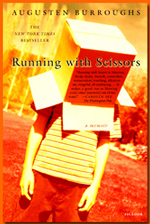
Book 1: Running With Scissors

By Augusten Burroughs

Needed something light for the flight home from my Xmas holiday in Vancouver. So at Lawrence’s used bookstore, I picked up this “hilarious childhood memoir” that has adorned the NYTs bestsellers list and been made into a Hollywood movie (which I heard had made some critic’s list of the one of the Worst Movies of 2006). Despite that, the book ended up being quite enjoyable, and helped pass a good chunk of my 5+ hour flight.

Burroughs grew up in small-town Massachusetts with a distant, alcoholic father and a crackpot mother with delusions of poetic grandeur. His parents inevitably divorced, and in the turmoil, he got legally adopted by his mother’s psychiatrist, the highly unorthodox Dr Finch, who may or may not be as deranged as some of his patients, if not more.

Thus the 12-year-old journal-keeping Burroughs came to live in the disorderly, dilapidated Victorian mansion with Dr Finch’s bizarre family comprised of his wife, two daughters, an absent adopted son, and an obsessive-compulsive patient who has never left her guest room since she stepped in two years previous.

Yup, “Running with Scissors” felt very much like a Wes Anderson film with some “One Flew Over the Cuckoo’s Nest” thrown in. You can see why Hollywood wanted to adapt this, as the cast of colourful characters ranged from the charmingly eccentric to the psychotically bananas. At times, it was a little hard to believe that every significant person in the author’s young life was some sort of unconventional oddball or nutcase. Even if some of the events were slightly exaggerated, still, you can’t make up some of the shit that went down in the Finch household (no pun intended).

The memoir covered a span of 4 years or so and comprised of very selective, yet cohesively narrative, vignettes. The tone was always kept somewhat light and casual, so you never felt like you could really get inside the author’s head of how it must have felt to have insanity rip your family apart.

Interestingly, Burroughs barely went to high school, but you can recognize that he nevertheless had a natural flair for writing and a sardonic wit. His editors must have had a field day correcting his spelling and grammar (why bother with learning such mundane things at school when you’re growing up in such a surreally entertaining environment). Although "Running With Scissors" didn’t exactly explore the depths of human emotions, it was ultimately a very good read with some touching, memorable moments.

Thursday, January 25, 2007

Year End Wrap Up – 15 Books for 2006! aka Better Late Than Never!

Great year! I exceeded my goal of reading slightly more than 1 book every month. For some reason, I lost steam after October with nothing read for the remaining year (although I started several books, none of them grabbed me enough to finish by year’s end.

Book 14: Kafka On the Shore

By Haruki Murakami
(Translated from Japanese by Philip Gabriel)


Mostly agree with dsgran’s summarized review of the same book see Book 7, except I wouldn’t call it a great book, per se, although it definitely had some great moments. Not as satisfying as The Wind-Up Bird Chronicle, disappointing in its unevenness and loose ends, and kind of lame in resorting to the clichéd device of “raining fish” (á la Magnolia). I also did not quite buy the March-November-Harold-and-Maude romance. Nevertheless, I kept getting drawn into Murakami’s surreal flights of unpredictability and the fascinating characters, such as the strangely androgynous Oshima and the cat-man Mr. Nakata. And then before I knew it, I finished the book!


Book 15: Necessary Betrayals

By Guillaume Vigneault


Picked this one up at the library after noting a decent review of it a while ago. It’s the debut novel of a young writer who lives and works as a bartender in the Plateau, the uber hip neighbourhood me & olman live.

Sadly, the book wasn’t so hip and it didn’t have much to do with living in the Plateau, or even Montreal, for that matter. Most of it takes place in the States because two brothers decide to go on a road trip and pick up a young woman along the way.

The older brother is old, not because he’s in his 30’s, but because he’s all washed-up due to some tragic event in his past. So he broods a lot while his younger brother is impulsive and slightly nuts. The woman is annoying because she is young, beautiful and hot, but she’s also surprisingly deep and smart. Of course, she has a big heart too because she falls in love with the older, washed up brother instead of the younger, wilder one even though she had sex with the younger one first, but it didn’t mean anything.

Ok, I think you’ve heard enough. This book pretty much felt like it was written by a bartender in his early-twenties who lives in the Plateau. It’s just too bad this one in particular had to be my last book for 2006.

Tuesday, September 19, 2006

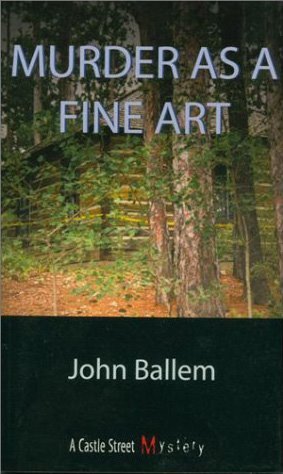
Book 13: Murder As a Fine Art

By John Ballem

This was read in August. I originally got this book for my dad since he enjoys reading mystery thrillers, plus I was still living in Banff and working at the Banff Centre for the Arts at the time. And I read a review saying that Ballem does a very good job of recreating the intimate community of artists doing short-term residencies in the famous artist colony. So I thought that this would give my dad a bit of an idea of what my experience was like, at least with hobnobbing and collaborating with artists at the Centre… not the part with psycho-killers and grisly murders!

However, other than prima donnas spazzing out, flamboyant egos clashing, and the worse thing of all, having to endure bad performance art every now and then… and believe me, there were some atrocious ones, and usually those ones make the headlines (there was once an artist from Mexico City who apparently masturbated at various well-known locations in the town of Banff, then presented the results of his work by carting around a dozen or so test tubes of his semen along Banff Avenue). So yup, other than that, there was never anything as exciting and dramatic as a juicy murder.

Anyway, I’m really too lazy to write a concise review of the novel (it took me over a month to get off my ass to even write this), so I’m quoting this excellent one from: http://gauntlet.ucalgary.ca/story/8198

"The novel opens with the discovery of Alan Montrose, who has fatally fallen down a flight of stairs in the Banff Centre for the Arts. Even though the death is classified as an accident, visual artist Laura Janeway becomes suspicious. Laura uses her keen sense of observation to work with the authorities to discover the truth, especially after a second death comes into play. Yet when she discovers a motive, she must dispel the suspect's air-tight alibi. It is obvious Ballem has a great knowledge of Banff and the Banff Centre. His accuracy not only allows those who have been to Sulphur Mountain or the Upper Hot Springs to mentally retrace their trip, but also includes those who have never seen Banff themselves. Ballem's use of details effectively illustrates the text and at the same time does not slow the book's pace. The characters are well developed and well described. Each character's individual art form is well researched and gives a sense of variety in the Centre. However, there are a few instances when Corporal Karen Lindstrom, the Mountie heading the investigation, and Laura Janeway appear to be the same person. This leads to some confusion."

So reading about psycho-killers and dead bodies, well, gave a slight whiff of unreality. At times I really had to force myself to suspend my disbelief, saying there’s no way that would ever happen at the Banff Centre, no matter how loopy the artist is! Nevertheless, Ballem did such a good job capturing the non-dramatic stuff this ultimately made a very enjoyable read with a fairly surprising, but kind of unlikely, twist at the end. For anyone who enjoys a decent mystery thriller, who wants to get a feel for what life is like being a residency artist at the BCFTA and being out n’ about in the town of Banff, then this book is worth checking out. Parts of it really took me back to those good ol’ days.

Thursday, August 17, 2006

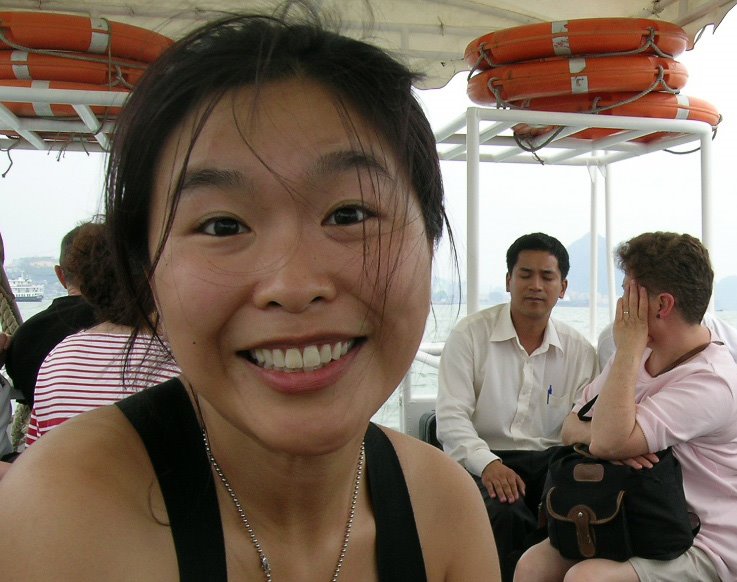
Meezly's Trip to Vietnam


Finally, what everyone has been waiting for, hehe...

vietnam gallery

...

Sunday, August 13, 2006

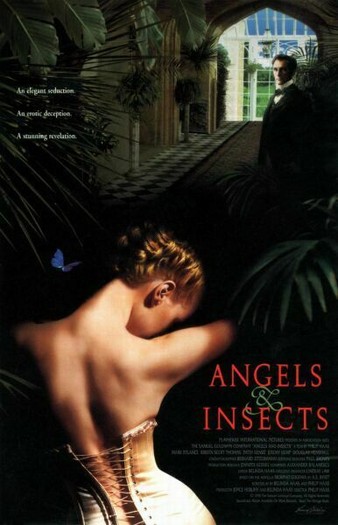
Book 12: Angels & Insects

by A.S. Byatt

Two novellas are found in this book, “Morpho Eugenia” (what the film Angels & Insects is adapted from) and “The Conjugial Angel”. I sought this out for the former, but frankly, couldn’t get through the latter, despite its cool subject matter: a motley circle of mediums and what they discover in the course of their semi-regular séances.

I’m not an A.S. Byatt fan, as this is the first book I’ve read of hers. But I do have a romantic fondness for 19th century natural science, the era that spawned Charles Darwin, so I naturally sought this work out. And it really delivered what I was hankering for. Byatt is really masterful at what she does, recreating the culture, language, aethetics and mindset of the Victorian period. There are beautiful passages detailing how the protagonist, an English naturalist, is esconced in the categorization of his benefactor’s animal and plant collection, his explorations and discoveries when he takes to long walks in the English countryside:

"His journal was for the first time alive with a purposeful happiness. He began also to collect insects, and was amazed to discover how many hundreds of species of beetle existed in a few square miles of rough moorland. He haunted the slaughterhouse, making notes on where the blowflies preferred to lay their eggs, how the maggots moved and chewed, the swarming, the pullulation, a mass of mess moved by an ordering principle. The world looked different, and larger, and brighter, not water-colour washes of green and blue and grey, but a dazzling pattern of fine lines and dizzying pinpoints, jet-black, striped and spotted crimson, iridescent emerald, sloppy caramel, slime-silver."

The story was also excellent, as I was surprised to find multiple complex and interesting themes and subplots woven into this dense, well-crafted 200 –page novella. Byatt’s obviously a big fan of Darwin, and she doesn’t disappoint in how she capably manages to integrate his evolutionary theories into, yes, a Victorian bodice-ripper. "Morpho Eugenia" deals with the Victorian obsession with Darwinian theories of breeding and sexuality, the parallels between insect and human society, the capture and taming of nature, and the age-old philosophical debate between religion and science. Heavy themes indeed, but hardly tedious at all. What distinguishes this story for me, is that these themes still ring true today, particularly the rift between those who believe in the comforting solace of divine design and those who understand and accept the pandora’s box of natural selection.

The character that portrays the religious side is Harald Alabaster, who’s struggling to write his magnum opus, “the kind of impossible book everyone now is trying to write. A book which shall demonstrate – with some kind of intellectual respectability – that is not impossible that the world is the work of a Creator, a Designer.” Alabaster is an intelligent, even wise, old man who once had his own radical views of evolution: “If I were a young man now, a young man such as you, I would be compelled towards atheistic materialism by the sheer beauty, the intricacy, of the arguments of Mr Darwin…” But now in his twilight years, he feels a desperate need to find some kind of meaning.

On the other hand, the protagonist, William Adamson, is a young naturalist who has accepted a creator-less universe. At Alabaster’s request, he’s invited into his study to read his drafts and play the devil’s advocate. Because Alabaster is also Williams’ benefactor, the naturalist has to bite his tongue at times:

William sat down in his father-in-law’s chair and tried to make sense of it, with mounting irritation. It was a new rehearsal of old arguments, some of which Harald had already, in conversation, rejected as untenable.

“… It may be an emotional deficiency in myself, Sir, that I cannot feel the strength of the argument. I have been much changed by the pattern of my life, of my work. My own father was very much in the image of a terribly Judge, who preached rivers of blood and destruction, and whose own profession was bloody too. And then the vast disorder – the indifference to human scale and preoccupations – in the Amazon – I have not been left with a propensity to find kindness in the face of things.”

Ah, the stuff of genius!

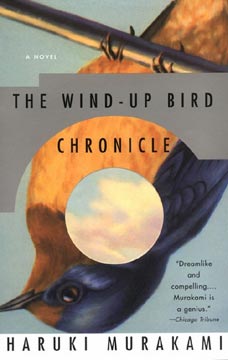
Book 11: The Wind-Up Bird Chronicle

by Haruki Murakami
(translated from Japanese By Jay Rubin)


I finally finished reading TWUBC back in June after my return from Vietnam, and for my first Murakami novel, it was a surprisingly rich and rewarding read. I didn't know anything about the author, only that he’s a well-regarded “Gen X” writer in Japan and he must have a decent following because I had some trouble finishing the library copy of this book because other people kept placing holds on it!

The novel begins by introducing the daily routine of recently unemployed Toro Okada. While his wife, Kumiko, goes to work during the day, Toro runs errands, makes lunch, reads, takes a nap, and prepares dinner for his wife’s return. The only conflict is that Toro and Kumiko have just lost their cat, and once in a while, Toro gets the odd strange phone call from an unknown woman. Other than that, nothing much happens.

Then Kumiko arranges for Toro to meet with a charismatic psychic to help them find their cat. And Toro starts to take walks around this neighbourhood, partly to search for the missing cat and partly to explore the abandoned house down the back alley. From there, various characters are introduced, and through their seemingly random histories, the novel expands into a multi-layered tale of near-epic proportion where we go back and forth between present-day Tokyo, the Mongolian front, a Soviet prison camp and a Shanghai zoo during WWII, as well as explorations into the subconscious netherworld of the protagonist’s mind. Before you know it, this self-effacing slacker embarks on a heroic quest to save his loved one!

The best thing about the book is that even though it quite capably juggles a confluence of Japanese history, personal tragedies, magic realism, the supernatural, operatic influences of The Magic Flute, not to mention over 600 pages of text… elements which contribute to an epic novel, the author still imbues a very subtle, low-key atmosphere. I hate to sound clichéd, but I find the approach zen-like, very Japanese, yet still familiar to the western reader. The only critique I had was the device of the wind-up bird to "tie things together", the only element which I found a bit too contrived.

Reading TWUBC was like watching a film by Ozu and Jarmusch. There’s a tension between reality and unreality; there’s a real-ness to Toro’s unassuming life, in how people go in and out of it, and a disconnected style to the writing and how the characters speak when describing bizarre events. So when things get progressively more surreal and Lynchian, it also seems to happen in the most normal and natural way. The protagonist, especially, has a sense of quiet acceptance and distance, even when he discovers there’s more to his slacker persona than he realizes. Like dsgran’s review, I appreciated how the story didn’t explain too much, like what exactly was the nature of Kumiko and her brother’s strange power? It made for a more interesting and enigmatic read. I’ll definitely be reading more by this author.

Friday, August 04, 2006

Otto... part cat, part sea otter!

Why dontcha take a load off, little buddy...